Fender Twin Reverb 1992 - Full NAM Capture Pack
Fender Twin Reverb 1992 - Full NAM Capture Pack
Couldn't load pickup availability
The Fender Twin Reverb is one of the defining voices of clean electric guitar. Its appeal isn’t simply that it stays clean, it’s the combination of clear attack, spacious chord definition, sparkling highs, and a firm foundation beneath the notes. This collection captures that mid-60's formula from an early-production example of the Fender ’65 Twin Reverb reissue built in March, 1992.
This particular amp adds two important ingredients: a quartet of NOS USA-made JAN PhilipsECG 7581A power tubes and a replacement baffle housing a single 4-ohm, 15" JBL K130.
The Twin occupies a different space from smaller Fender amps that give up their clean sound more readily. Its high-powered output section and solid-state rectifier provide the foundation for a clear, firm response, allowing the character of the guitar and the player’s attack to remain prominent.
That’s the heritage behind this early ’65 reissue: the expansive clean voice associated with the blackface Twin, captured here through an individual combination of vintage American power tubes and a single-15" speaker conversion.
USA-made JAN PhilipsECG 7581A power tubes
The power section is fitted with four JAN PhilipsECG 7581A tubes. The 7581A is a member of the 6L6 family. These tubes have earned an enthusiastic following among players seeking strong clean performance from big Fender amps. Descriptions of the Philips 7581A often emphasize its headroom and bass authority. Here, they’re a part of the formula that make this amp special.
A single 15" JBL
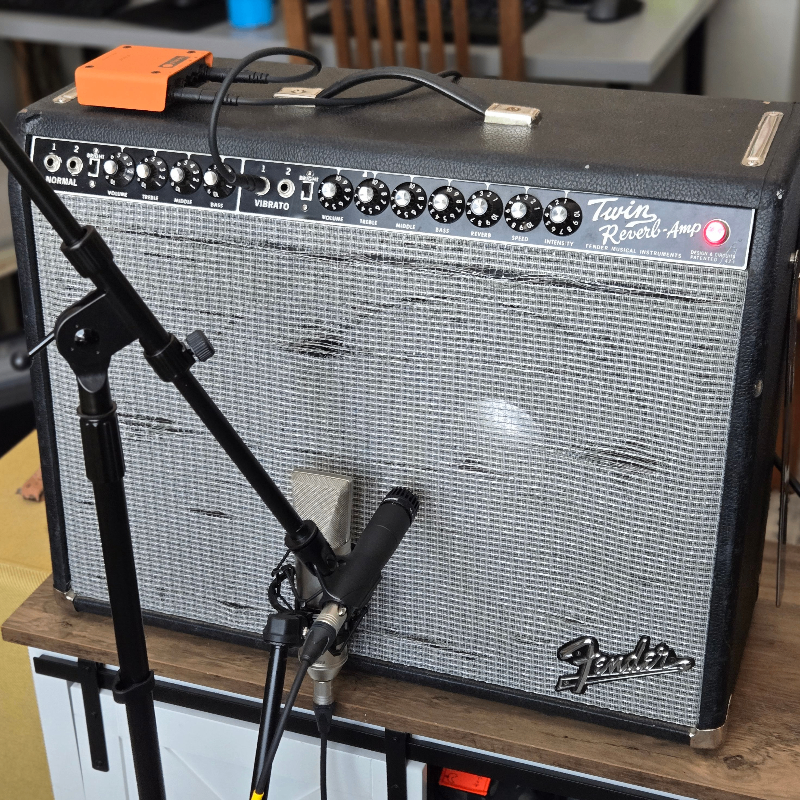
The replacement baffle houses one 15" JBL K130 rated at 4 ohms, replacing the Twin’s familiar two-speaker arrangement. For the full-rig models, that actual speaker was captured using Shure SM57 and RODE NT2 microphones.
What’s included
- 28 NAM models total:
- 14 DI models for use with your own cabinet IRs
- 14 full-rig models featuring the installed 15" JBL K130
- Captures sourced from the actual 1992 tube amp.
Two ways to use the amp
DI models
The DI collection lets you bring this Twin into your existing cabinet workflow. Captured from the Twin through a reactive load, these models leave speaker out of the chain so you can pair the amp with your preferred cabinet IRs.
Full-Rig models
Captured through the amp’s 15" JBL K130 using SM57 and Rode NT2 microphones. These include the captured speaker sound, with no additional cabinet IR needed.
Source amp details
- Model: Fender ’65 Twin Reverb reissue
- Build date: March 26, 1992
- Chassis and transformer dates: 1991
- Circuit board date: 1991
- Cabinet date code: “CA,” indicating January 1992
- Assembly sticker: March 1992
- Tubes:
- V1: Fender-branded, Chinese-made 12AX7
- V2: Electro-Harmonix 7025
- V3: Groove Tubes 12AT7
- V4: Electro-Harmonix 7025
- V5: Unmarked 12AX7 tube
- V6: JJ 12AT7 / ECC81, Apex balanced and matched
- Power tubes: USA-made JAN PhilipsECG 7581A
- 15" JBL K130 4ohm dated February 1993
Reamp chains
DI: MOTU M4 > Lehle P-Split III > Twin Reverb > Fryette PS-2A > MOTU M4
Full rig: MOTU M4 > Lehle P-Split III > Twin Reverb with 15" JBL K130 > SM57/Rode NT2 > MOTU M4
The models that are amp‑only DI captures are taken from the amplifier head into a reactive load. They do not include any speaker cabinet or microphone simulation. To achieve a complete guitar tone, you will need to place your own cabinet IR or cab simulator after the NAM plugin in your signal chain.
The models that are a complete rig are recoreded through the amplifier head and speaker cabinet. They are ready to go and do not require an additional impulse response.
Because these captures preserve the natural behavior of the real amplifier, different presets are intentionally recorded at their genuine relative levels. Some settings—particularly high‑gain or high‑master presets—will be naturally louder, while cleaner or lower‑master presets will be quieter. This is expected and by design. Please use your DAW or NAM’s output controls to match loudness between presets to taste while keeping the underlying dynamics intact.
Share